
A few years ago, mapping a city's road network from satellite imagery took weeks of manual digitizing. Analysts would sit in front of a screen, tracing roads pixel by pixel, building by building.
Today, an AI model does it in hours.
That's GeoAI in a sentence the collision of artificial intelligence and geospatial science, producing capabilities that would've seemed like science fiction a decade ago. And we're still in the early innings.
If you've read about GIS or remote sensing and wondered where all of this is heading, you're asking exactly the right question. GeoAI is the answer and it's moving fast.
What Is GeoAI?
GeoAI short for Geospatial Artificial Intelligence is the application of machine learning, deep learning, and AI techniques to geographic and spatial data. It sits at the intersection of three fields: GIS, remote sensing, and artificial intelligence.
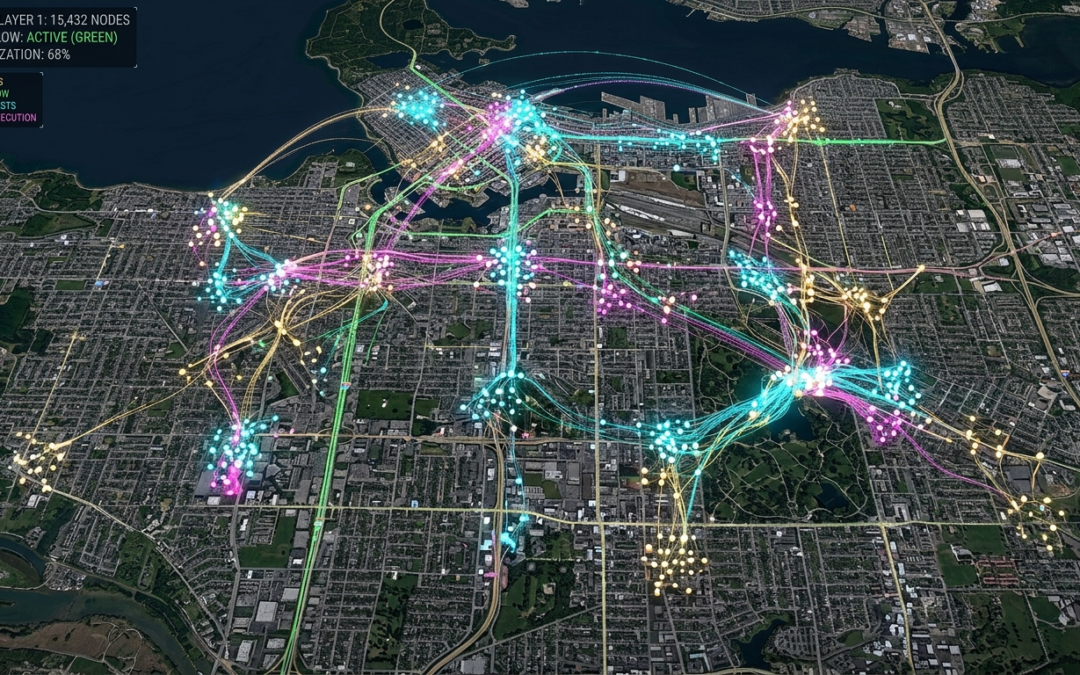
The core idea is straightforward: geographic data is complex, massive, and deeply patterned. AI is exceptionally good at finding patterns in complex, massive datasets. Put them together and you get a system that can do things no human analyst could do alone at a scale and speed that changes what's possible.
Think of it this way. Traditional GIS asks: "What is here?" Remote sensing asks: "What does it look like from above?" GeoAI asks: "What does it mean and what's going to happen next?"
Real-World GeoAI Applications Already in Use
GeoAI isn't theoretical. It's running in production systems right now, across sectors you'd recognize.
Disaster Response: Faster Than Any Field Team
When disasters strike, speed saves lives. AI in geospatial science has dramatically compressed the time between an event and actionable damage assessment.
After the 2023 Moroccan earthquake, AI models trained on before-and-after satellite imagery automatically detected collapsed structures within 24 hours before most international response teams had even landed. The UN's UNOSAT program uses GeoAI routinely for exactly this kind of rapid mapping.
Climate and Environmental Monitoring
Manually reviewing decades of satellite imagery to track environmental change is a monumental task. GeoAI automates it.
Global Forest Watch, operated by the World Resources Institute, uses machine learning on satellite imagery to detect deforestation alerts in near real time. When illegal logging starts in a protected area, the system flags it within days sometimes before local rangers are even aware. That's spatial data analysis working at a planetary scale.
Urban Intelligence and Smart Cities
City planners are using GeoAI to analyze urban growth, model traffic flow, map informal housing, and predict infrastructure failures. Microsoft's Building Footprint project used deep learning to map over 700 million building footprints globally from aerial imagery a dataset that would've taken centuries to produce manually.
Singapore's Virtual Singapore platform combines GeoAI with 3D city modeling to simulate everything from shadow patterns to emergency evacuation routes. It's one of the most sophisticated geospatial AI systems any government has built.
Agriculture: Precision at Scale
Satellite imagery plus AI is transforming how the world grows food. Machine learning GIS models now predict crop yields weeks before harvest, detect pest infestations from subtle spectral changes in vegetation, and optimize irrigation at a field-by-field level.
The startup Descartes Labs processes petabytes of satellite data through AI pipelines to forecast commodity crop production globally information that moves agricultural markets and informs food security policy.
The Challenges GeoAI Still Needs to Solve
It's not all breakthroughs and headlines. GeoAI has real limitations worth understanding.
Training data is a bottleneck. AI models need labeled examples to learn from. Creating high-quality labeled geospatial datasets is expensive and time-consuming and models trained in one region often fail to generalize to another.
Explainability is murky. A deep learning model might correctly identify a flood-affected area, but can't always tell you why it made that call. In high-stakes decisions disaster response, infrastructure investment, legal land disputes black-box outputs make stakeholders nervous.
Geographic bias is real. Most training data comes from well-mapped, high-income regions. Models built on North American or European data often underperform in the Global South, precisely where accurate geospatial intelligence is most needed and least available.
These aren't unsolvable problems. But they're honest ones and the GeoAI research community is actively working on all three.
Frequently Asked Questions About GeoAI
How is GeoAI different from traditional GIS?
Traditional GIS tools are rule-based a human defines the analysis logic. GeoAI learns the logic from data. Instead of manually coding "a road looks like this," you show the model thousands of roads and it figures out the pattern itself. GeoAI doesn't replace GIS; it supercharges it.
What skills do you need to work in GeoAI?
A solid GeoAI practitioner typically combines GIS or remote sensing knowledge with Python programming and familiarity with machine learning frameworks like TensorFlow or PyTorch. You don't need all three on day one but building toward that combination opens the most doors in the field.
What software and tools are used in GeoAI?
Common tools include Google Earth Engine (cloud-based geospatial analysis), ArcGIS with AI extensions (ESRI's ecosystem), PyTorch and TensorFlow (deep learning), and open-source libraries like Rasterio, GeoPandas, and TorchGeo. Many workflows also run on cloud platforms like AWS, Google Cloud, or Microsoft Planetary Computer.
Is GeoAI only for large organizations?
Not anymore. The democratization of satellite data (free Sentinel and Landsat archives) and open-source AI tools means individuals and small teams can build meaningful GeoAI pipelines. University research groups, NGOs, and independent developers are publishing serious GeoAI work every month.
Where GeoAI Is Headed
Three things to remember from everything above:
- GeoAI combines the spatial intelligence of GIS and remote sensing with the pattern-recognition power of modern AI producing capabilities neither could achieve alone.
- It's already operational in disaster response, climate monitoring, agriculture, and urban planning not a future concept.
- The field is wide open foundation models, better training datasets, and improved explainability will define the next five years.
Geospatial artificial intelligence is rapidly becoming one of the most consequential applications of AI in the physical world. Not because it's flashy but because the Earth has problems that need solving, and GeoAI is one of the sharpest tools we've built to solve them.
Curious to go deeper? Explore NASA's Prithvi foundation model on Hugging Face, or start experimenting with Google Earth Engine's built-in machine learning tools. The barrier to entry has never been lower and the ceiling has never been higher.